Gelatin got strange on the internet. The protein itself didn't.
An eight-minute read on collagen, connective tissue and what actually changes in a man's body after fifty — including the claims we think you should ignore.
What men actually report
It isn't pain. It's friction.
Almost nobody books an appointment for this. It shows up as small negotiations with your own body — the ones you've quietly started making.
The first twenty minutes
You get out of bed and move like the machine needs to warm up before it will cooperate. By mid-morning it's fine. It's the boot sequence that changed.
Recovery took over the calendar
The workout is still possible. It's the two or three days afterwards that now have opinions about it, so you train less than you'd like to.
Stairs became information
Knees, hips and shoulders started reporting on things they used to handle silently. Nothing alarming. Just noticeably present.
Protein stopped being optional
Muscle and connective tissue both get harder to maintain with age, and most men over fifty eat well under what the research suggests they need to hold onto either.
Where it comes from
A stockpot, not a laboratory
Gelatin is one of the oldest processed foods there is. Simmer bones, hide and connective tissue long enough and the collagen inside them unwinds into something that dissolves in hot water and sets when it cools.
Every food culture with livestock arrived at it independently: French consommé, Jewish p'tcha, Korean seolleongtang, the aspic in a British pork pie. Broth was never a wellness ritual. It was what you did so nothing went to waste.
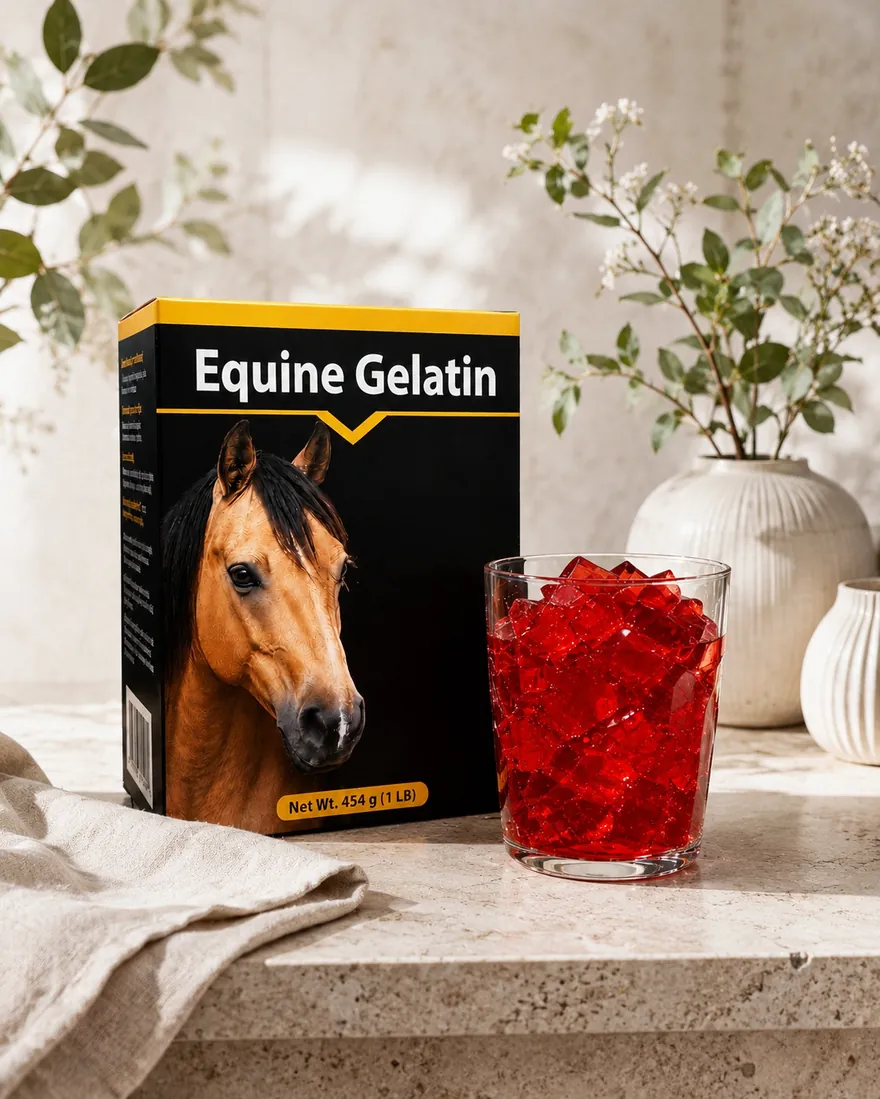
Powdered gelatin — the box on your counter — is just that process industrialised, dried and standardised so it behaves the same way every time.
The ingredient, plainly
Equine gelatin
Gelatin is named for its source animal, and horse is one of several — alongside bovine, porcine and fish. The source affects sourcing, price, religious and dietary suitability, and bloom strength.
What it does not do is change the protein into something else. Equine, bovine and porcine gelatin are all hydrolysed type-I collagen: the same amino acid backbone, unusually rich in glycine, proline and hydroxyproline. There is no published evidence that horse-sourced gelatin acts differently in the body from any other kind.
Why we're bothering to say this
The interesting thing about gelatin is boring: it's a cheap, complete-ish protein with an amino acid profile you don't get much of elsewhere in a modern diet. The interesting thing about equine gelatin is nothing at all. If a page tells you the horse is the reason it works, that page is selling you the horse.
Sorting the claims
Three things the internet says. One of them is half true.
We'd rather lose the sale than repeat these. Here is where each claim actually stands.
"Horse gelatin is far more potent than the regular kind — that's the secret men aren't told."
No. This is marketing folklore. Source animal changes gel strength and sourcing, not what the amino acids do once digested. Anyone leading with the horse is leading with the story.
"Eating collagen rebuilds the collagen in your joints — it goes straight where it's needed."
Not literally. It's digested into amino acids and peptides like any protein. Trials on collagen peptides do show modest improvements in joint discomfort and function, but the mechanism is not direct delivery.
"It's just protein. You already eat chicken, so it does nothing extra."
Half true — and the half that isn't is the interesting part. Gelatin is a poor standalone protein, low in some essentials. But it's unusually dense in glycine and proline, which most modern diets are short on because we stopped eating the connective parts.
If you want to try it
Three steps, and none of them are exciting
This is a food you're adding to a diet, not a protocol. The whole method fits on an index card.
Anchor it to something you already do
Habits survive when they attach to an existing one. Most men stir it into the first hot drink of the day, because that already happens without a decision. Coffee, tea, broth — anything hot enough to dissolve it.
Use a real amount, consistently
Studies on collagen peptides generally use around 10 to 15 grams a day — roughly a heaped tablespoon. A pinch does nothing. Follow the dosing on whatever product you buy, and take it daily rather than when you remember.
Give it a season, then judge honestly
The trials that found effects ran for eight to twenty-four weeks. Write down how the first twenty minutes of your morning feel now, look again in three months, and be willing to conclude it did nothing for you.
Read before you buy anything
Six reasons to close the tab
Applies to us as much as anyone else. If a page selling gelatin does any of the following, it is not being straight with you.
It promises a specific number
"Twelve years off your joints." Nobody can quantify that for you individually, and no gelatin study supports a figure like it.
It touches erections or testosterone
There is no credible evidence linking gelatin or collagen to sexual function or hormone levels. This is the most common hook aimed at men over fifty, and it is invented.
It says doctors are hiding it
Gelatin has been in the food supply for centuries and sits on supermarket shelves. There is no suppression narrative available for a baking ingredient.
It has a countdown that resets
Refresh the page. If the timer starts over, the scarcity is fake, and you should assume the rest of the page is authored to the same standard.
It shows before-and-after photos
Nothing about connective tissue or joint comfort is photographable. Any imagery implying otherwise is illustrating something it did not measure.
It tells you to stop your medication
No supplement page should ever do this. If you take anticoagulants, have kidney disease, or manage a chronic condition, ask your doctor before adding a daily protein supplement — including this one.
From reader mail
What men wrote back
Composite notes drawn from correspondence after we first ran this piece. They describe experiences, not outcomes we're promising you.
"I was ready for this to be another miracle powder. It isn't one. I put a spoon in my coffee, I've kept it up since spring, and the mornings feel less like negotiating. That's the whole report."
"The part that actually changed my mind was the section telling me what not to believe. I'd already been sold the horse story twice by then and half fallen for it."
"Three months in and honestly I couldn't swear it's doing anything. I've kept taking it because it's protein and it costs less than the fish oil I gave up on. Make of that what you will."
Illustrative composite examples. Individual results vary. Not a guarantee. Names and locations are fictional; the notes are assembled from reader correspondence and do not depict identifiable individuals.
Questions we get
Seven answers, no hedging
General
Is this a medicine?
No. Gelatin is a food. Nothing here is intended to diagnose, treat, cure or prevent any disease, and it should not replace anything your doctor has prescribed.
Who should not take it?
Anyone with a known allergy to the source animal, and anyone whose doctor has restricted their protein intake — kidney disease being the common case. If you're on anticoagulants or managing a chronic condition, ask first. Pregnancy and breastfeeding: ask first.
How long before I know if it's working?
Published trials on collagen peptides typically ran eight to twenty-four weeks before measuring. Plan on three months of daily use and a genuinely honest assessment at the end, including the possibility that the answer is no.
Does this page make money if I buy?
Yes. This is an advertisement and we're compensated when a reader purchases through the link below. That's precisely why the warnings section exists: it's the part of the page that costs us money to include.
About the gelatin
Why equine rather than bovine or porcine?
Mostly sourcing, supply and dietary suitability — some people avoid pork or beef for religious or personal reasons. It is not because horse gelatin is stronger. It isn't.
What's the difference between gelatin and collagen peptides?
Both come from collagen. Gelatin gels when it cools and needs hot liquid to dissolve; collagen peptides are hydrolysed further, dissolve in cold liquid and don't set. Nutritionally they're close. Most of the joint research used the peptide form.
Can I just make bone broth instead?
Yes, and it's cheaper. The catch is dose consistency — homemade broth varies enormously in gelatin content, and hitting ten to fifteen grams a day reliably is hard. Powder solves a logistics problem, not a nutrition one.
Continue reading
The rest of the note is on the next page.
It covers the sourcing, the dosing, and what the product we recommend actually costs — including the part where we tell you it might not be worth it for you.
Read the full noteAdvertisement. Not medical advice. These statements have not been evaluated by the Food and Drug Administration. This product is not intended to diagnose, treat, cure or prevent any disease. Consult a qualified healthcare professional before starting any supplement.